
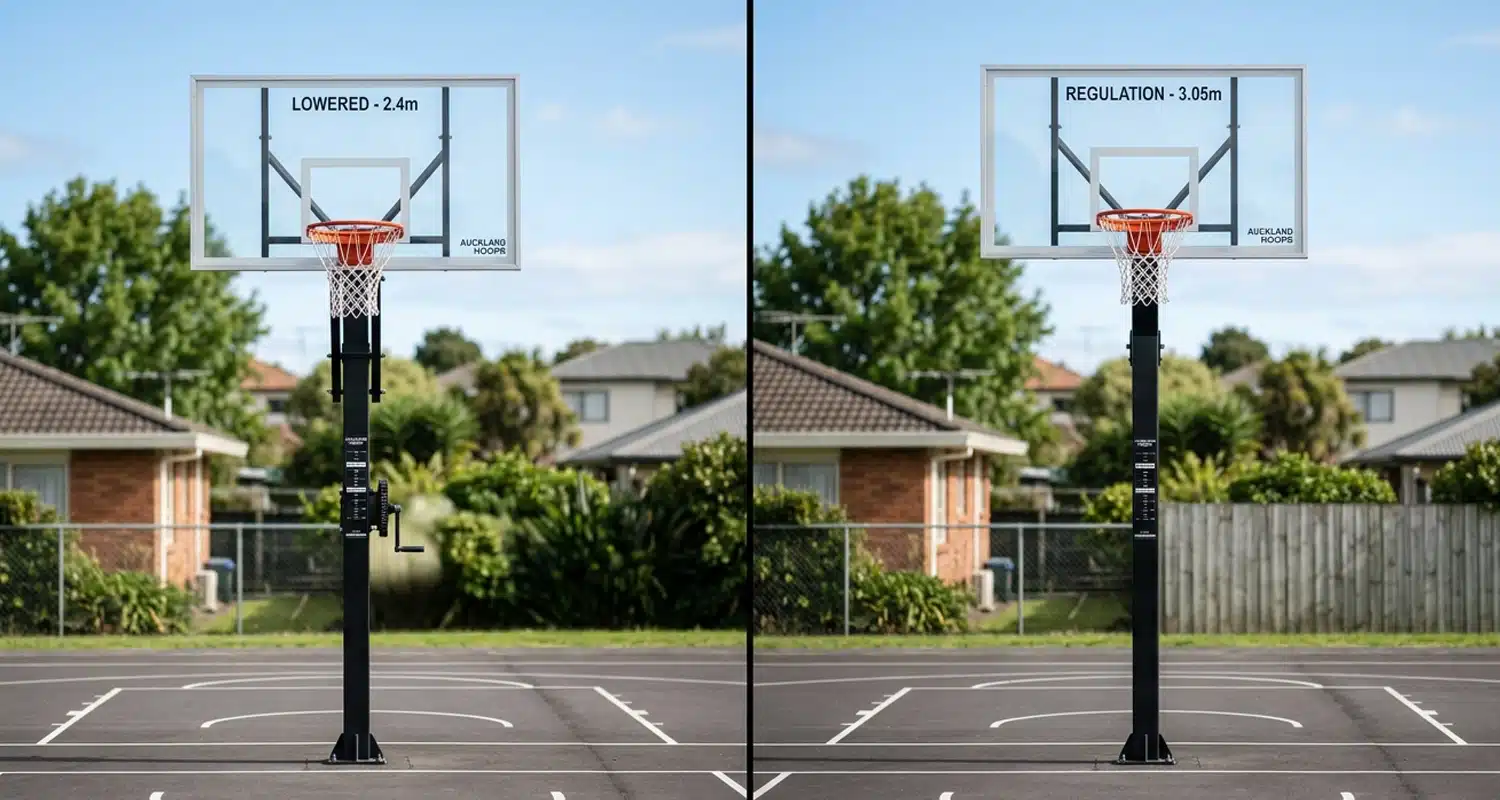
Choosing between an adjustable and fixed basketball hoop isn’t about picking the better product. It’s about picking the right one for your setup.
Most buyers aren’t deciding between good and bad. They’re deciding between flexibility and permanence. An adjustable basketball hoop in NZ suits households or venues with mixed ages and changing needs. A fixed hoop suits courts that want a steady, long-term setup from day one.
The right choice comes down to four things: where the court is, who’ll be using it, how seriously they’ll play, and how permanent the installation needs to be. Work through those four questions, and the answer usually becomes obvious.
| Feature | Adjustable Hoop | Fixed Hoop |
|---|---|---|
| Height range | ~2.1 m to 3.05 m | Fixed at 3.05 m (regulation) |
| Best for | Families, mixed ages, multi-use courts | Clubs, schools, dedicated courts |
| Installation | In-ground, anchored in concrete | In-ground, anchored in concrete |
| Structural complexity | Height adjustment mechanism | Simplified pole design |
| Suitable for dunking | Yes (in-ground models) | Yes |
| Backboard options | Tempered glass, acrylic | Tempered glass, perforated steel |
| Grows with players | Yes | No |
| Typical warranty (Goalrilla) | Limited lifetime | Limited lifetime |
| NZ weather suitability | Powder-coated steel | Powder-coated steel |
An adjustable basketball hoop lets you change the rim height, typically anywhere from 2.1 m (7′) up to the regulation 3.05 m (10′). Height changes are made using a crank actuator, a spring-assist system, or a counterbalance mechanism, depending on the model.
Most quality adjustable systems, like those in the Goalrilla range available through Court Kings, are in-ground designs anchored in concrete. That means you get full stability and regulation performance, but with the added ability to drop the height for younger or shorter players when needed.
Adjustable hoops work at regulation height too. The “adjustable” part doesn’t limit how the hoop performs at 10 feet; it just means it doesn’t have to stay there.
A fixed basketball hoop is set permanently at one height, almost always the regulation 3.05 m (10′). There’s no mechanism to raise or lower it. What you install is what you play on.
Fixed hoops are typically in-ground systems anchored in concrete and built for heavy use. Goalrilla’s fixed-height range, for instance, uses Three-Point Technology, a one-piece pole, dual extension arms, and a triple-joint connection, to deliver a pole design that’s stronger than their adjustable equivalents. They’re designed specifically for settings where height adjustment is never going to be needed.
If everyone using the court is playing at regulation height and the setup is long-term, a fixed hoop removes one moving part, literally and figuratively.
If kids are going to be the primary users, or if there’s a wide age range using the court, an adjustable basketball hoop is the practical choice. Playing on a 3-metre hoop at age 7 isn’t just frustrating; it teaches bad habits. Kids develop poor shooting mechanics trying to heave the ball at a rim that’s too high.
Dropping to 2.4 m (8′) or 2.7 m (9′) keeps the game enjoyable and helps younger players build proper form. Then as they grow, the hoop grows with them.
Goalrilla’s in-ground adjustable systems adjust from 7.5′ to 10′ using an all-steel actuator that even young players can operate. That’s the kind of practical design that makes a difference over years of use.
If the court is going to be used for more than just basketball, think netball, training drills, or school PE sessions with varying age groups, an adjustable setup gives you far more flexibility. A court that works for Year 5 students in the morning and adults in the afternoon needs a hoop that can shift between those needs without any drama.
An adjustable outdoor basketball hoop is a long-term investment in the truest sense. You’re not buying a “kids’ hoop” that gets replaced in a few years. You’re buying one piece of equipment that works for a 6-year-old learning to shoot and a 16-year-old training for rep basketball. For residential buyers especially, that longevity makes the adjustable option hard to argue against.
Once players are training at regulation height consistently, adjustability stops being a benefit and starts being an unnecessary variable. Fixed hoops remove that entirely. The rim is always at 3.05 m. The setup is identical every session. For players training seriously, whether that’s a school’s First V squad or a private backyard court for a serious teenager, that consistency matters.

Schools, sports clubs, and council facilities almost always benefit from fixed hoops. The reasons are practical: there’s no adjustment mechanism to maintain or for unsupervised users to tamper with, the structural design is simpler and typically more rigid, and the hoop is always set to the standard competition height.
Goalrilla’s fixed-height 72″ systems are specifically designed for residential and commercial settings like schools, universities, private outdoor courts, and apartment complexes. The perforated steel backboard option is worth noting for high-use public spaces where glass vandalism is a concern.
Fixed hoops have fewer moving parts. There’s no actuator, no height-adjustment housing, and no mechanism that could wear or fail over years of heavy use. If the court is going to be heavily used and low maintenance is a priority, a fixed setup is built for exactly that.
Most driveway courts are residential, and most residential driveways are used by kids and adults together. An adjustable hoop wins here in most cases. Space is usually limited too, so a 60″ backboard is often the right size, as it is large enough for proper play without hanging too far over the driveway.
Backyard courts give you more freedom. If you’re building a full-size or half-court surface with ProBaller turf, you’ve already committed to a proper setup, and the right hoop should match that investment. Families with younger kids should go adjustable. Households of serious adult players may prefer the simplicity and rigidity of a fixed system at regulation height.
An indoor basketball hoop setup, that is typically wall-mounted, works slightly differently. Wall-mounted systems anchor directly to a structural wall rather than the ground, making them ideal for gyms, hall spaces, and covered courts where floor installation isn’t possible. Many wall-mount options offer height adjustability too, but the key constraint is wall integrity. Always have a professional assess the wall before installation.
An outdoor basketball hoop in New Zealand faces real weather demands from UV exposure, humidity, wind, and temperature swings between summer and winter. In-ground installation with powder-coated steel and tempered glass is the standard for outdoor setups that need to last. Both adjustable and fixed systems in the Goalrilla range are designed to handle outdoor conditions year-round. The difference between them comes back to who’s using it, not where it is.
Regulation basketball height is 3.05 m (10 feet). A full size basketball hoop also refers to the backboard, which has a regulation of 72″ x 42″. That’s the size used in high school, university, and professional competition.
A 60″ backboard is a strong all-round option for driveways and medium-size courts, and a 54″ suits tighter spaces without sacrificing too much of the playing experience.
A common misconception is that “adjustable” and “full size” are opposites. They’re not. Most quality adjustable systems reach the full 10-foot regulation height and can carry a 72″ tempered glass backboard.
The adjustment mechanism doesn’t compromise performance at regulation height; it just gives you the option to play lower when it’s useful.
If everyone using the court is in their mid-teens or older and playing at a reasonable level, a regulation height and 72″ backboard is worth the investment. It mirrors what players will encounter in competition, and it builds better instincts for shooting, rebounding, and spacing.
A hoop that shakes after every rebound isn’t just annoying, it affects play and, over time, puts stress on the connection points between the pole, extension arms, and backboard. Goalrilla’s STBLZR Technology (available on the CV series) actively reduces post-impact movement, returning the hoop to its resting position quickly.
For in-ground systems, the concrete anchor is what delivers the foundation. Portable hoops filled with water or sand simply can’t replicate that.
Tempered glass backboards offer the best rebound performance, causing the ball to behave the way experienced players expect. But glass requires some care in high-traffic or unsupervised public settings. Acrylic is a solid alternative: lighter, cheaper, and less vulnerable to vandalism. Perforated steel is the choice for exposed public courts where durability and resistance to damage come first.
All Goalrilla systems use powder-coated steel poles. That coating protects against rust and UV degradation, which are both relevant in New Zealand’s coastal and high-UV environments.

New Zealand’s UV index is among the highest in the world. Uncoated steel or low-grade finishes won’t hold up. Salt air in coastal areas accelerates corrosion faster than buyers often expect.
Powder-coated steel and UV-stable backboard materials aren’t a premium feature here; they’re a basic requirement for anything expected to last more than a few years outdoors.
In-ground adjustable hoops require a concrete anchor installation, typically with a sleeve or plate system that sets in concrete over 48–72 hours before the pole is attached. The actuator mechanism should be checked periodically for smooth operation and lubricated if needed.
Goalrilla’s anchor system allows the pole to be unbolted and relocated if circumstances change, which is a genuine advantage for residential buyers who may move.
Fixed in-ground hoops follow the same concrete anchor installation process. With no adjustment mechanism, ongoing maintenance is simpler: the main tasks are checking anchor bolts periodically and keeping the backboard clean.
The trade-off is that if you ever want the hoop at a different location or height, you’re looking at a reinstall from scratch.
Our team, led by Bevan Williamson with 15+ years of artificial turf expertise and former professional basketball player Hayden Allen, installs hoops as part of full court builds. That means the hoop position, overhang depth, and anchor location are all planned alongside the court surface itself, not bolted on as an afterthought.
We use Goalrilla systems because they’re built to a commercial standard and backed by a limited lifetime warranty. Getting the installation right matters as much as the product itself.
Work through these questions to find your answer:
Go adjustable if:
Go fixed if:
Consider your backboard size:
Court Kings is NZ-owned and operated, with nationwide service and free no-obligation quotes. We supply and install Goalrilla hoops as part of complete court builds with ProBaller turf surfaces, line marking, lighting, and fencing, or as standalone hoop installations on existing surfaces.
We work with residential clients building backyard courts, schools setting up multi-use court facilities, sports clubs upgrading ageing infrastructure, and councils building community court spaces. Every quote is scoped to the actual site and the actual players, not a standard package applied to every job.
If you’re not sure whether an adjustable or fixed setup is right for your court, we’ll give you a straight answer based on your space, your users, and your budget.
Yes. For most residential buyers and any venue serving mixed-age groups. The ability to lower the rim for younger players isn’t just a convenience; it genuinely helps kids develop proper shooting technique.
Quality adjustable systems like Goalrilla’s in-ground range deliver full regulation performance at 10 feet, so you’re not sacrificing anything for adult play.
Fixed hoops do have a structural advantage. No adjustment housing means a simpler, more rigid pole design. But the bigger stability factor for any in-ground hoop is the concrete anchor installation. A properly installed adjustable Goalrilla system is extremely stable. For dunking and aggressive play, in-ground installation matters far more than whether the hoop is adjustable or fixed.
Yes. Most quality adjustable in-ground systems reach the full regulation 3.05 m (10 feet) and are available with regulation-sized 72″ x 42″ backboards. “Adjustable” refers to the height range and doesn’t limit the maximum height or backboard size.
Goalrilla’s adjustable range reaches full competition spec.
For most driveways, adjustable is better. Driveways are predominantly residential spaces used by people of different ages and heights. The ability to drop the rim makes the court usable for younger players and means you won’t be replacing the hoop as kids grow.
A 60″ backboard with an adjustable in-ground system is a common and practical choice for driveway courts.
An in-ground system with powder-coated steel and a tempered glass or acrylic backboard. NZ conditions (high UV, humidity, and coastal salt air in many areas) demand materials that won’t corrode or degrade quickly.
Portable hoops deteriorate faster outdoors and don’t deliver the stability or rebound quality of a properly anchored in-ground system. The choice of adjustable or fixed depends on who’s using it.
A 60″ backboard is the best all-round choice for most residential and school courts. It’s large enough for proper play and comfortable to install on most sites.
Go to 72″ if space allows and players are at a competitive or serious level; this is regulation size and mirrors what players will encounter in competition. A 54″ suits tighter spaces or setups where younger players are the main users.
SEO By 